Issue 01
Sonja Rychkova
Interview with Sonja Rychkova – a portrait of the young painter in her studio on a warm August afternoon.
Interview and photos:
Ruth Maren Neubert
Frankfurt, August 23, 2025
SONJA RYCHKOVA
born in 1998 in Darmstadt
Studied painting at HfG Offenbach under Professor Heiner Blum and Mike Bouchet
currently lives in Frankfurt am Main
RUTH MAREN NEUBERT
Kunst, Interview
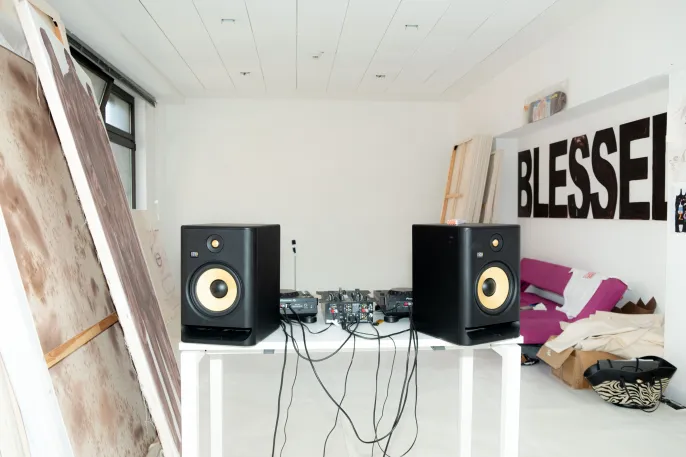
Sonja’s studio right in the middle of Frankfurt’s high rise jungle is a long space lined with white painter’s foil. The sunlight blinds me a little as I enter street sounds of people and cars filter in. Sonja hands me an ice cold Coke Zero. We sit down on her bright purple couch. I spread my papers around me and give her a few forms to sign before we start.
So professional! I once had a shoot with a TV station a little documentary about young artists – it was terrible. Luckily the videographer didn’t have the consent form with him so I was able to withdraw my agreement.
This guy was rude. He was editor and videographer in one and he interviewed me back then in my studio in Offenbach. At some point I didn’t want to answer something and he accused me of being too bitchy. “In the end the viewers will think what a ***** she is.” Can you imagine?
After that we drove to Kranichstein where I grew up. On the way he kept making comments and I had to really hold myself together. I kept thinking: “We just drive to Kranichstein and then we’re finally done.” So I showed him everything there the area the places I had spent a lot of time. At one stop he told me to say “I used to live here I made it out and the others are still here.” – That was it for me. No way in hell I would ever say something like that.
Sounds like he came with a pre-set storyline and tried to force you into it – the poor girl turned emerging talent.
Exactly that’s what I realized too. When he came back a month later with the rough cut I was shocked. He had cut me together with Olexesh just because he’s also from Kranichstein. I love Olexesh, but it didn’t fit at all. Luckily I was able to withdraw my consent and reported everything to his superior.
Which shows yet again what kind of idiots are sometimes in rooms you haven’t entered yet. I often thought only geniuses sit there – until I got inside and saw they’re just regular people boiling water like everyone else.
You just need the courage to enter those rooms. People overthink it beforehand and imagine others as superhuman. In the end they’re just normal. And if you take the chance and dare to step in a lot can come from it. Of course you also have to contribute something substantial courage alone isn’t enough but it’s still an important part. Just Do It fits. Or as I always say nothing comes from nothing.
“People overthink it and imagine others as superhuman.“
Right. Back to your work. Smile Now Cry Later – that was the first of your works that really got written about.
Exactly, my first solo show at Ruttkowski (Cologne April – June 2024.)
In your exhibition text it says that in L.A. you were inspired by your own upbringing in the ghetto. Was the word ghetto deliberately chosen?
The term ghetto has a personal meaning for me since I grew up in a neighborhood often called that. For me it carries not just stigma but also memories of solidarity and identity. Because the word can easily be misunderstood I deliberately worked with Francesco Ortega, professor of Chicano Studies in Las Vegas. He guided the process and wrote the text framing the term not as derogatory but as culturally formative similar to the Chicano barrios. It was important to me that the text didn’t come from the gallery but from someone with real expertise and understanding of different social realities. Francesco set the frame beautifully. It was especially meaningful that someone from the Lowrider community did this to guarantee authenticity and avoid misunderstandings or quick accusations of cultural appropriation a term that today is often used superficially without real knowledge.
“I was often ashamed that we had no money and wished I were German because I associated that with wealth.“
So how did Smile Now Cry Later come about?
I grew up in Kranichstein at the bottom of the social ladder. I was often ashamed that we had no money and wished I were German because I associated that with wealth. Every day I came home from kindergarten wishing for blonde curls blue eyes and a German last name. I rarely brought friends home because that shame was so deep. Upgrading through clothes became a tool for me. That runs through my work. Migrants are often pushed into places labeled problem areas or ghettos. But in the end they’re just places where people live socially disadvantaged, often with migration backgrounds.
At some point I read an essay by Ortega in which he wrote that Lowrider and Chicano culture are often misrepresented always reduced to gangs crime violence. That exists but people forget the beauty of the culture where people find strength and belonging. I could identify with a lot of that. Clothing plays a big role there too signaling identity and strength. That was like my own childhood. My best friend and I used clothes as a tool to position ourselves in society.
I always wanted to go to America so I flew there. I stayed for two weeks couldn’t afford more. I met many great people. It was simply beautiful. Some had powerful stories and I thought I want to paint them. A painting holds the moment and that’s what I did.
Basically documentation. Do you still keep in touch?
Yes with some. We still write on Instagram. I want to go back. The exchange was great; new things but also many parallels.
“Producing was fun but the research was awful.”
I loved your references in Perpetual Motion Machine, your last work Hannah Arendt, Eisenhower, Foucault. What a mix. I wish I had more time and energy to dive into texts like that. I feel like I’m reading four books at once and never finish any.
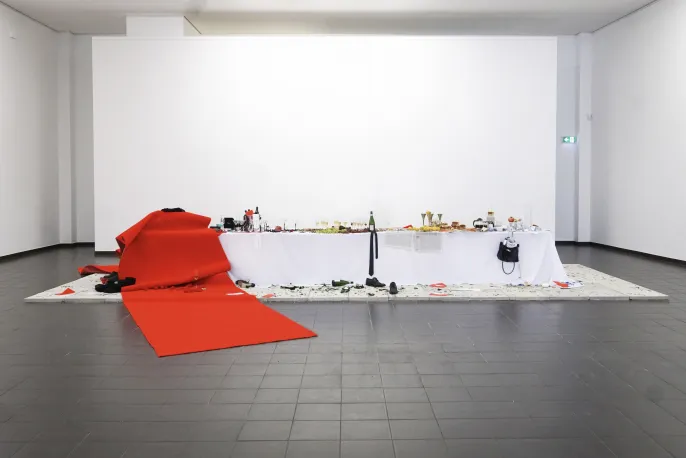
Thanks. At the beginning of the year I went to the IDEX arms fair in Abu Dhabi to research for that work. War machinery and weapons. It felt good to work differently for once. Not painting but sculpture and sound. Painting the theme would have been too blunt. Producing was fun but the research was awful. It really pulled me down. We’re so numb right now. War has become background noise.
Besides Arendt, Eisenhower and Foucault what else do you read?
My best friend recently gave me Emrata’s book very good. I think every woman can relate to the themes. It’s a quick read. In her case it’s extreme because of her exposure but every woman struggles with the same problems in some shape or form I guess.
“I’ll buy her painting then she’ll have dinner with me.”
The same stigmas – like videographers not taking you seriously. Still, you have to be above it. Do you think that’s also a theme for you Pretty privilege or being judged as less competent because you’re generally seen as attractive?
Yes that’s been an issue. It's been said that my collectors were lawyers buying into a pretty artist as in: "I’ll buy her painting then she’ll have dinner with me". Which was never true, half my collectors are queer. There was a period with many such accusations and it dragged me down. People need to realize hate and bullying have consequences. Not everyone has friends or support to process it. Words can kill. I even think it’s wild Justin Bieber is still alive. He was so young when it all started probably didn’t understand what was happening. The amount of hate he got and still gets is shocking.
That’s why I get the thing with Britney and Pamela. I feel like Britney has mentally given up. Pamela somehow managed, which I find hugely impressive, considering the media attention. But Britney doesn’t seem well, you can’t tell me the pressure back then didn’t contribute.
When I earn good money later I want to start an anti mobbing foundation.
Speaking of later: I read that your grandfather was a sculptor. With Perpetual Motion Machine you moved from canvas into space for the first time. Is sculpture your end goal?
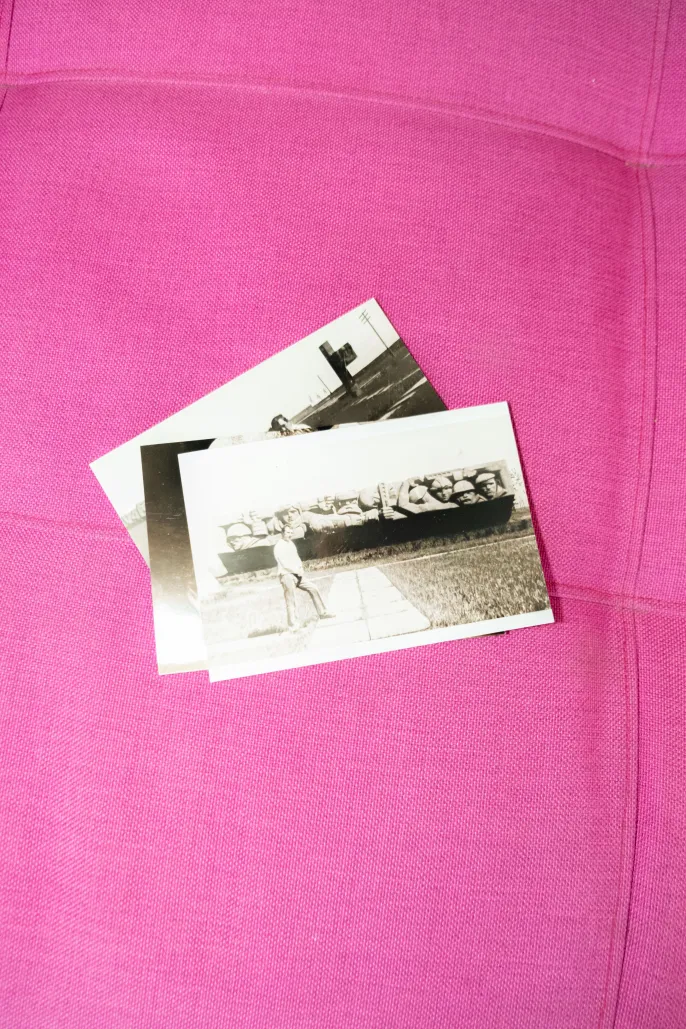
I knew as a kid that my grandfather was a sculptor but only now do I understand what he actually did.
My family doesn’t talk about it much but last New Year’s Eve my father sent me photos. His monuments still stand all over Russia. I showed the pictures to my professor Mike Bouchet and his first comment was that he sees many parallels to my work.
The formats distortions strong poses. I never met my grandfather but I think I could have learned a lot from him. That’s a shame. When I studied art I quickly thought sculpture would be the final boss but I still lack the money or commissions. Bronze at that scale is expensive. I look forward to making my first sculptures.